Transaction Structure
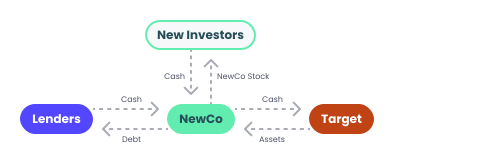
Below is a simple diagram of an LBO structure. The new investors (e.g. and LBO firm or management of the target) form a new corporation for the purpose of acquiring the target. The target becomes a subsidiary of NewCo, or NewCo and the target can merge.
Applications of the LBO Analysis
- Determine the maximum purchase price for a business that can be paid based on certain leverage (debt) levels and equity return parameters.
- Develop a view of the leverage and equity characteristics of a leveraged transaction at a given price.
- Calculate the minimum valuation for a company since, in the absence of strategic buyers, an LBO firm should be a willing buyer at a price that delivers an expected equity return that meets the firm’s hurdle rate.
Steps in the LBO Analysis
- Develop operating assumptions and projections for the standalone company to arrive at EBITDA and cash flow available for debt repayment over the investment horizon (typically 3 to 7 years).
- Determine key leverage levels and capital structure (senior and subordinated debt, mezzanine financing, etc.) that result in realistic financial coverage and credit statistics.
- Estimate the multiple at which the sponsor is expected to exit the investment (should generally be similar to the entry multiple).
- Calculate equity returns (IRRs) to the financial sponsor and sensitize the results to a range of leverage and exit multiples, as well as investment horizons.
- Solve for the price that can be paid to meet the above parameters (alternatively, if the price is fixed, solve for achievable returns).
Returns
In LBO transactions, financial buyers seek to generate high returns on the equity investments and use financial leverage (debt) to increase these potential returns. Financial buyers evaluate investment opportunities with by analyzing expected internal rates of return (IRRs), which measure returns on invested equity. IRRs represent the discount rate at which the net present value of cash flows equals zero. Historically, financial sponsors’ hurdle rates (minimum required IRRs) have been in excess of 30%, but may be as low as 15-20% for particular deals under adverse economic conditions. Hurdle rates for larger deals tend to be a bit lower than hurdle rates for smaller deals.
Sponsors also measure the success of an LBO investment using a metric called “cash-on-cash” (CoC). CoC is calculated as the final value of the equity investment at exit divided by the initial equity investment, and is expressed as a multiple. Typical LBO investments return 2.0x – 5.0x cash-on-cash. If an investment returns 2.0x CoC, for example, the sponsor is said to have “doubled its money”.
The returns in an LBO are driven by three factors, which we demonstrate in our topic on creating value in LBOs:
- De-levering (paying down debt)
- Operational improvement (e.g. margin expansion, revenue growth)
- Multiple expansion (buying low and selling high)
Risk
Equity holders – In addition to the operating risk assumed risk arises due to significant financial leverage. Interest costs resulting from substantial amounts of debt are “fixed costs” that can force a company into default if not paid. Furthermore, small changes in the enterprise value (EV) of a company can have a magnified effect on the equity value when the company is highly levered and the value of the debt remains constant.
Debt holders – The debt holders bear the risk of default equated with higher leverage as well, but since they have the most senior claims on the assets of the company, they are likely to realize a partial, if not full, return on their investments, even in bankruptcy.
Exit Strategies
Ideally, an exit strategy enables financial buyers to realize gains on their investments. Exit strategies most commonly include an outright sale of the company to a strategic buyer or another financial sponsor, an IPO, or a recapitalization. A financial buyer typically expects to realize a return on its LBO investment within 3 to 7 years via one of these strategies.
Exit Multiples
The value of a company acquired in an LBO transaction is often value at the time of acquisition using valuation multiples (e.g. EV/EBITDA). While exiting the investment at a multiple higher than the acquisition multiple will help boost a sponsor’s IRR, it is difficult to justify a prediction that the exit multiple will be higher than the entry multiple (known as “multiple expansion”). It is important that exit assumptions reflect realistic approaches and multiples (exit multiples should generally equal acquisition multiples) for analytical purposes, and multiple expansion is usually an unjustifiable assumption.
Issues to Consider in an LBO Transaction
Industry characteristics:
- Type of industry
- Competitive landscape
- Cyclicality
- Major industry drivers
- Potential outside factors (politics, changing laws and regulations, etc.)
Company-specific characteristics:
- Strategic positioning within the industry (market share)
- Growth opportunity
- Operating leverage
- Sustainability of operating margins
- Potential for margin improvement
- Level of maintenance CapEx vs. growth CapEx
- Working capital requirements
- Minimum cash required to run the business
- Ability of management to operate effectively in a highly levered situation
Market conditions:
- Accessibility and cost of bank and high yield debt
- Expected equity returns
Characteristics of a Good LBO Candidate
The following characteristics define the ideal candidate for a leveraged buyout. While is it very unlikely that any one company will meet all these criteria, some combination thereof is need to successfully execute an LBO.
- Strong, predictable operating cash flows with which the leveraged company can service and pay down acquisition debt
- Mature, steady (non-cyclical), and perhaps even boring
- Well-established business and products and leading industry position
- Moderate CapEx and product development (R&D) requirements so that cash flows are not diverted from the principle goal of debt repayment
- Limited working capital requirements
- Strong tangible asset coverage
- Undervalued or out-of-favor
- Seller is motivated to cash out of his/her investment or divest non-core subsidiaries, perhaps under pressure to maximize shareholder value
- Strong management team
- Viable exit strategy
Management Buyouts (MBOs)
Management buyouts are similar to LBO, except that the management team of the target company acquires the company rather than a financial sponsor. For example, the sole owner of a private company might be nearing his twilight years and wishes to exit the business he started years ago. The management team might believe strongly in the prospects of the company and agree to buy out the owner’s equity interest and assume control of the company.